





Metal Stamping for Custom Sheet Metal Parts
Custom metal stamping for sheet metal components requiring punching, forming, bending and repeat production, with tooling, secondary operations and surface finishing coordinated around the finished part.
Metal Stamping for Repeat Sheet Metal Production
We manufacture custom stamped metal components through blanking, piercing, forming and bending processes selected according to part geometry, material, production quantity and tooling requirements.
Stamping is especially suited to repeat production where dedicated tooling can combine multiple operations into a controlled and consistent manufacturing sequence.
Blanking produces the required metal blank as the part itself, while piercing creates holes or openings within the sheet or strip.
Stamped blanks can be formed, bent or drawn into functional shapes according to the final component geometry.
Dedicated dies and controlled feeding support consistent production for repeated part geometry and larger production runs.
Material, strip layout, part geometry, forming depth, critical dimensions and expected production quantity should be reviewed before the tooling and stamping route are confirmed.
Stamping Processes for Custom Metal Components
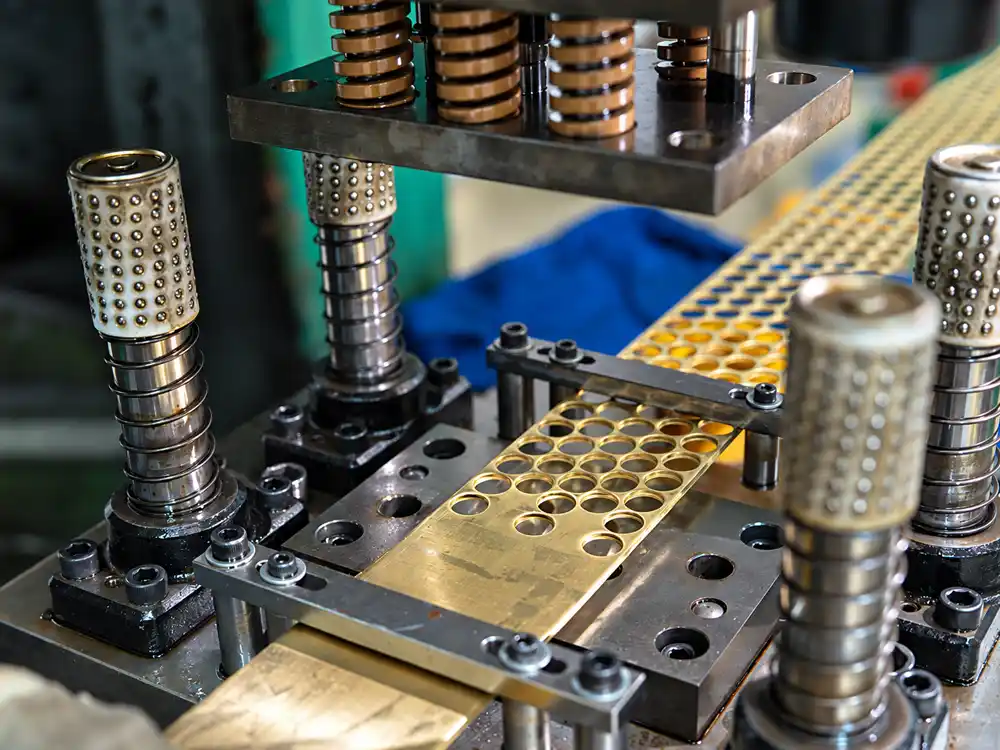
Metal stamping can combine cutting and forming operations to manufacture repeat components from sheet or coil material with controlled geometry and consistent production sequences.
The stamping route is selected according to part geometry, material, production quantity, forming requirements and the tooling strategy required for stable repeat production.
Blanking & Piercing
Blanking separates the required part or intermediate blank from sheet or strip material, while piercing creates holes, slots and internal openings within the component.
Forming & Bending
Stamping dies can form flanges, bends and other three-dimensional features directly into sheet metal parts according to the final component geometry.
Progressive Stamping
Progressive dies can perform multiple cutting and forming operations as strip material advances through a sequence of stations before the finished part is separated.
Custom Tooling & Repeat Production
Die structure, strip layout and operation sequence are developed around the component geometry and expected production quantity before repeat stamping begins.
Tooling strategy should be reviewed together with material, part geometry, forming sequence, critical dimensions and expected production volume rather than selecting the stamping method from a single feature alone.
Materials and Design Requirements for Stamped Metal Parts
Material grade, sheet thickness and forming behavior all influence die design and the stamping sequence. Part geometry should be reviewed together with blank layout, bend direction and critical dimensions before tooling is finalized.
Features such as holes near edges, narrow webs, formed walls and cosmetic surfaces may require additional consideration to maintain stable production and the required finished-part condition.
Metals Commonly Used for Stamped Components
Commonly used for brackets, clips, structural components and mechanical parts requiring strength, repeat forming and optional plating or coating.
Suitable for corrosion-resistant stamped parts, clips, covers and formed components where material strength and surface condition are important.
Used for lightweight stamped components, panels, brackets and formed parts that may later receive anodizing or other surface treatments.
Selected for electrical contacts, terminals, small formed components and other parts requiring conductivity, corrosion resistance or good formability.
Part Features That Affect the Stamping Route
Material strength, hardness, thickness and temper condition influence cutting force, forming behavior and tooling design.
Bend geometry and material springback should be considered when defining formed angles, flange dimensions and tooling compensation.
Hole-to-edge distance, narrow webs, slots and closely spaced features should be reviewed in relation to material thickness and deformation risk.
Burr orientation, contact faces, mating surfaces and visible areas should be identified where they affect assembly, handling or downstream finishing.
Plating, passivation, coating, deburring and other downstream operations should be considered before the stamping route and final part condition are confirmed.
Final tooling decisions should be based on the complete drawing, material condition, part geometry, expected production volume and any critical forming or surface requirements rather than on nominal dimensions alone.
From Stamping Tooling to Finished Metal Parts
Metal stamping production extends beyond the press operation itself. Tooling setup, feeding, forming sequence, deburring, secondary operations and finishing should be coordinated around the final component requirements.
Reviewing the complete production route before repeat manufacturing begins helps control formed geometry, functional surfaces, assembly features and the condition required after surface finishing.
Die configuration, strip or blank layout, feeding direction and operation sequence are prepared around the approved part geometry.
Blanking, piercing, forming and bending operations are carried out according to the selected die and production sequence.
Stamped parts can undergo deburring, trimming, tapping, reaming or other follow-up operations where required by the final component.
Welding, riveting, fastening or component assembly can be coordinated where the stamped part forms part of a larger fabricated structure.
Plating, passivation, coating, anodizing and other specified finishes can be planned according to material and final application requirements.
Finished parts are checked against confirmed dimensional, forming and surface requirements before protective packaging and shipment.
Tooling, forming sequence, burr direction, secondary operations and surface finishing should be reviewed together before repeat production is released.
Inspection Control for Stamped Metal Parts
Stamped parts should be checked not only for individual dimensions, but also for overall formed geometry, datum relationships and the position of functional features that affect downstream assembly.
Dedicated checking fixtures can be used to locate formed sheet metal parts in a repeatable position while critical contours, holes, flanges and assembly relationships are verified against the confirmed part requirements.
Reference surfaces and locating points are used to position the stamped part consistently during inspection.
Overall profile, formed surfaces, flanges and key structural features can be checked against the dedicated fixture or confirmed drawing.
Hole locations, slots, mounting points and other functional features are reviewed according to their relationship with the established datum system.
Mating areas, fastening positions, burr condition and visible surfaces can be reviewed before the part proceeds to assembly, finishing or shipment.
Inspection methods should follow the confirmed drawing, datum scheme, critical dimensions, formed geometry and functional requirements. Dedicated checking fixtures, gauges and other measuring tools can be selected according to the part and production stage.
Typical Stamped Metal Parts We Support
Metal stamping supports a wide range of repeat-production components, from simple blanks and clips to formed brackets, electrical contacts and multi-feature sheet metal parts.
The production route is selected according to part geometry, material, forming sequence, tooling requirements and any secondary operations required after stamping.
Brackets & Mounting Parts
Stamped brackets, supports and mounting components combining pierced holes, formed flanges, bends and functional locating features.
Clips, Clamps & Retainers
Small stamped components designed for positioning, retention, spring action or mechanical fastening within larger assemblies.
Contacts & Terminals
Precision stamped contacts and terminals with cut, pierced and formed features for electrical connection and assembly.
Washers, Discs & Metal Blanks
Flat stamped components and intermediate blanks produced from sheet or strip material before direct use or further forming.
Covers, Shields & Plates
Stamped covers, shields and plate components with holes, openings, formed edges and surface requirements for mechanical or protective applications.
Formed Supports & Stamped Assemblies
Multi-feature stamped parts and formed subcomponents that may require secondary operations, joining or surface finishing before final assembly.
These examples are representative rather than limiting. Custom stamped parts can be reviewed from drawings or CAD files according to material, thickness, geometry, expected production volume, tooling requirements and downstream finishing.
What to Send for a Metal Stamping Quote
A clear drawing or CAD file together with material, thickness, production quantity and forming requirements helps us review the stamping route, tooling approach and project cost.
For repeat-production projects, expected order volume and any downstream operations should be identified during the initial quotation review.
Provide the latest 2D drawing, 3D model or other available technical documentation showing the finished part geometry.
Specify the required material grade, sheet or strip thickness and any temper or material-condition requirements.
Identify important hole positions, bends, flanges, formed areas, datum references and other features that affect fit or function.
Provide prototype, initial order and expected repeat-production quantities so the tooling and production route can be reviewed appropriately.
Identify any deburring, tapping, reaming, welding, riveting, assembly or other follow-up operations required after stamping.
Specify plating, passivation, coating, anodizing, cosmetic requirements, inspection documents or other project-specific finishing requirements.
Tooling cost and production method depend on part geometry, material, forming sequence and expected volume. Early project information helps determine whether single-operation, compound or progressive tooling is more suitable.
Need a Metal Stamping Quote?
Send us your drawing or CAD file together with material, thickness, quantity, critical dimensions, forming requirements and any secondary processing or surface finishing requirements.
We can review the part geometry, tooling approach and production route before preparing a quotation for your project.
Send Your Stamping Requirements
Drawings, material details and expected production volume help us evaluate tooling and manufacturing requirements more accurately.
Request a Quote